Listable: Unicorn Platform Alternative for Directory Websites
A detailed comparison of Listable and Unicorn Platform for building directory websites. See how a purpose-built directory builder compares to a general website builder.
On this page
- What is Listable
- What is Unicorn Platform
- Listable vs Unicorn Platform: Feature Comparison
- Why Choose Listable Over Unicorn Platform
- Purpose-built for directories
- Launch faster with less setup
- Built-in monetization
- Structured data and search
- Submissions and moderation
- Cleaner UX and user flow
- When Unicorn Platform Might Be Better
- Listable vs Unicorn Platform: Pricing
- Final Thoughts
If you’re looking to build a directory website, you’ve probably come across both Listable and Unicorn Platform as potential options. Both are no-code platforms, but they take fundamentally different approaches to building directories.
This comparison breaks down how each platform handles the features that matter most when building a directory, so you can decide which is the better fit for your project.
What is Listable
Listable is a directory website builder designed specifically for creating and managing directories. Every feature, from the data model to the admin dashboard, is built around directory use cases.
Out of the box, you get listing submissions, custom fields, search and filtering, paid listings, SEO tools, bulk CSV imports, and category management. There’s no need to piece together third-party tools or figure out workarounds - directory functionality is native.
What is Unicorn Platform
Unicorn Platform is a no-code website builder primarily designed for creating landing pages and simple websites. It uses a block-based editor that lets you visually assemble pages from pre-built components.
While it’s possible to create a directory-style layout on Unicorn Platform, it doesn’t have built-in directory-specific features. You’d need to manually structure your content and rely on external tools for things like submissions, filtering, and payments.
Listable vs Unicorn Platform: Feature Comparison
Here’s how the two platforms compare on features that matter for directory websites:
| Feature | Listable | Unicorn Platform |
|---|---|---|
| Custom domain | Yes | Yes |
| SSL certificate | Yes | Yes |
| SEO tools | Directory-optimized | Basic meta tags |
| Custom fields | With search/filter support | No |
| Listing submissions | Built-in with moderation | No |
| Paid submissions | Built-in (Stripe) | No |
| Search & filtering | Built-in, field-based | No |
| Bulk CSV import | With AI column mapping | No |
| Category management | Built-in with hierarchy | Manual page creation |
| Claim listings | Growth+ | No |
| Share leads with owners | Pro | No |
| Private directories | Pro | No |
| Role-based access | Pro | No |
| Themes & templates | Directory-specific themes | Landing page templates |
| Blog | Yes | Yes |
| Payment integration | Stripe, PayPal (native) | Limited / external |
| Hosting | Fully managed | Fully managed |
Why Choose Listable Over Unicorn Platform
Purpose-built for directories
The biggest difference is specialization. Listable was designed from the ground up for directories. That means every feature works together around a directory data model - listings, categories, custom fields, submissions, and search are all first-class features.
With Unicorn Platform, you’re adapting a general-purpose website builder to behave like a directory. That means manually creating pages for each listing, no structured data relationships, and no built-in way for users to submit or search listings.
Launch faster with less setup
Listable’s setup wizard gets you from zero to a working directory in minutes. You define your categories, configure your fields, set your theme, and you’re live. Submissions, payments, and SEO are already wired up.
On Unicorn Platform, building anything resembling a directory requires significant manual work: creating individual pages, structuring content blocks to look like listings, and integrating external services for any interactive features.
Built-in monetization
Listable supports common directory monetization strategies natively:
- Pay to list - charge a one-time fee or subscription for listing submissions
- Pay to feature - charge for premium placement and visibility
- Gated access - restrict directory content behind a paywall
These work out of the box with Stripe and PayPal integration. On Unicorn Platform, monetizing a directory requires third-party payment tools and custom workarounds.
Structured data and search
Directories live or die by their search experience. Listable gives you custom fields with built-in search and filtering, so visitors can find exactly what they’re looking for. Listings have structured data that powers both the search experience and SEO.
Unicorn Platform’s block-based editor doesn’t support structured data or field-based filtering. There’s no native search functionality for directory-style content.
Submissions and moderation
A key part of any directory is accepting new listings. Listable has a complete submission flow with customizable forms, moderation queues, and optional payment gates. Listing owners can manage their own content.
Unicorn Platform doesn’t offer user submissions. Every listing would need to be manually created by you through the editor.
Cleaner UX and user flow
Listable’s interface is designed to be clean and intuitive - from the admin dashboard to the public-facing directory. Because it’s purpose-built for directories, there’s no fighting a generic page builder to make it behave like one. Less clutter, fewer clicks, and a more polished experience for both you and your visitors.
This is something users consistently highlight:
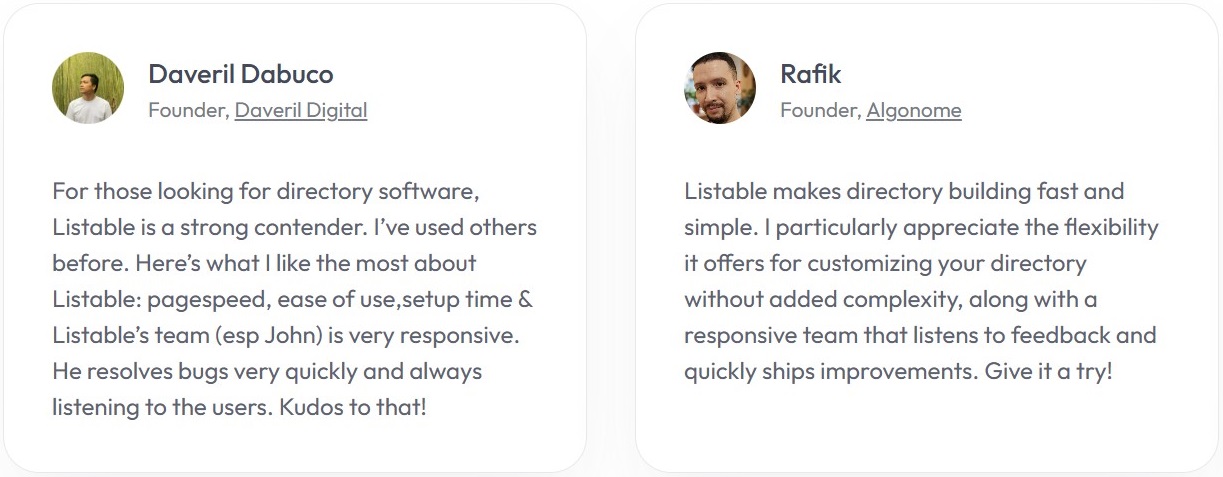
A directory builder isn’t just about the feature list - it’s about how those features feel to use day-to-day.
When Unicorn Platform Might Be Better
Unicorn Platform is a solid choice if you’re not actually building a directory. It excels at:
- Landing pages - its block editor makes beautiful one-page sites quickly
- Simple marketing sites - company pages, product launches, portfolios
- Visual customization - if pixel-perfect design control matters more than directory functionality
If your project is primarily a marketing site that happens to have a small, static list of items, Unicorn Platform’s visual editor could work. But once you need dynamic submissions, search, filtering, or payments, you’ll hit its limitations.
Listable vs Unicorn Platform: Pricing
| Listable | Unicorn Platform | |
|---|---|---|
| Starting price | $9.99/mo | $14/mo |
| Lifetime option | From $119 | No |
| Submissions | Yes | No |
| Payments | Growth plan+ | No |
| Custom fields | Yes | No |
| Search & filtering | Yes | No |
Listable offers three plans - Starter ($9.99/mo), Growth ($19.99/mo), and Pro ($29.99/mo) - each also available as a lifetime one-time purchase from $119. Even Listable’s entry-level plan includes a custom domain, submissions, SEO tools, and priority support. Payment acceptance, lead collection, and claim listings are available on Growth and above.
To replicate even Listable’s Starter features on Unicorn Platform, you’d need to integrate multiple external services, adding both cost and complexity.
Final Thoughts
Unicorn Platform is a capable website builder for landing pages and simple sites. But if you’re building a directory, you’ll spend more time working around its limitations than actually building your directory.
Listable is purpose-built for the job. Submissions, search, filtering, SEO, bulk imports, and moderation are included out of the box. The quality of templates and ease of use mean you get a polished, professional-looking directory faster, with less effort, and with room to grow.
If you’re also evaluating other directory builders, see our Listable vs Directify and Listable vs DirectoryEasy comparisons.
Ready to build your directory?
Listable gives you everything you need to launch a directory website - no plugins, no workarounds, no code.
- Launch in minutes with the setup wizard
- Accept submissions with built-in forms and moderation
- Monetize from day one with native payment integration